Coming Back After Three Weekends Off: Why Week One Hurts More Than It Should
Quick Answer: After three weekends off, your aerobic fitness has barely moved, your muscles have lost almost nothing, and your tendons and coordination have lost a surprising amount. That mismatch is why week one feels awful: your engine is still willing, your connective tissue and movement timing are not, and the gap is exactly where weekend injuries happen.
The fix is two short weekday sessions, not a heroic first game back.
So before you write off the whole month, it helps to know which parts of you actually went on holiday.

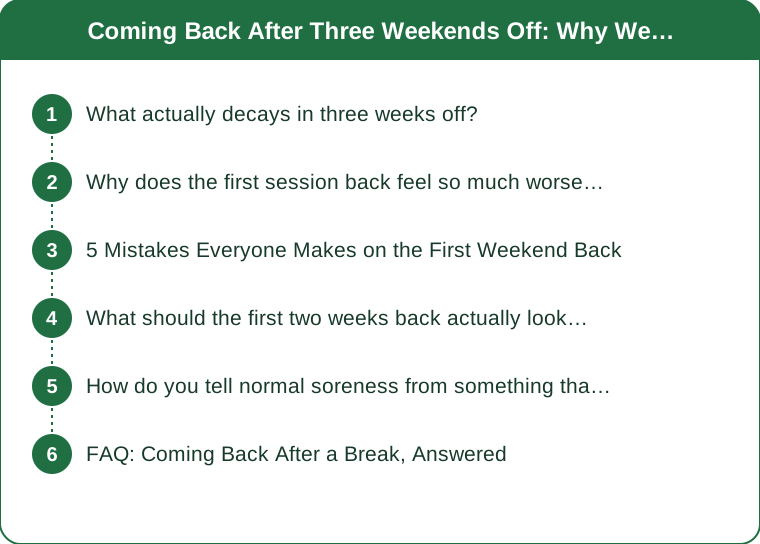
What actually decays in three weeks off?
Less than you fear in some systems, more than you expect in others, and the uneven pattern is the whole problem.
Aerobic capacity holds up well. Short layoffs of two to three weeks produce small reductions in VO2 max in trained people, and much of the early drop is blood plasma volume rather than anything structural. Plasma volume falls within days of stopping, which raises your heart rate at any given effort. That is why the first run back feels harder at the same pace even though your actual fitness is close to intact. Plasma volume comes back within a session or two.
Muscle size and strength barely move. Three weeks is not long enough for meaningful atrophy in someone who was training regularly. What you lose first is neural: the ability to recruit fast, to brace hard, to produce force in the first fraction of a second.
Tendon stiffness drops faster than muscle. Tendon adapts more slowly than muscle in both directions, and this asymmetry is the single most useful thing to understand about coming back. Your quads can still generate the force they did in July. Your patellar tendon has spent three weeks not being loaded and is less prepared to absorb it.
Coordination and timing degrade quietly. Sport-specific movement patterns are motor skills, and skills fade with disuse. A change of direction that was automatic now takes conscious thought, which means it is a fraction slower and slightly less well organised.
Put those together and you get the classic profile: an engine that can push you into intensities your tissue and your timing are not ready for.
Why does the first session back feel so much worse than the numbers say?
Because three separate things stack on the same afternoon.
Higher heart rate at the same effort. Reduced plasma volume means less blood returning per beat, so your heart compensates with rate. You look at your watch, see a number you associate with hard work, and conclude you have lost everything. You have mostly lost water.
Higher perceived effort from disrupted rhythm. Breathing rhythm, cadence, and pacing are learned patterns. Off for three weeks, you go out too fast, spike early, and spend the rest of the session in debt.
Delayed onset soreness at a level you had forgotten. Repeated bout effect is the protection you build against muscle damage from familiar exercise, and it fades over weeks. Your first session back produces markedly more soreness than the same session did a month ago, and it peaks around 48 hours later, which is why Tuesday is the day people regret Saturday.
The useful reframe: the awful feeling is a poor guide to actual fitness. It is measuring your adaptation state, not your capacity. Two sessions later most of it is gone.
5 Mistakes Everyone Makes on the First Weekend Back
1. Treating the first game as a test. People come back wanting to know where they stand, and testing yourself is exactly the wrong use of a session where your tissue tolerance is at its lowest point of the year.
2. Skipping the warm-up because you feel fresh. Three weeks of rest makes you feel bouncy at the start, which is precisely when a cold tendon is least ready for a maximal sprint. Feeling fresh is not the same as being prepared.
3. Playing the full match. The last twenty minutes of a first game back is where the injuries cluster, because coordination degrades fastest under fatigue and yours started the day already blunted.
4. Doing nothing during the week and everything on Saturday. This is the structural version of the weekend warrior problem, and a break makes it worse rather than resetting it.
5. Chasing the lost weeks. The instinct after time off is to add volume to catch up. The third mistake is the one that actually causes most injuries, but this is the one that turns a single bad weekend into a six-week problem, because it stacks a training error on top of an already elevated tissue risk.

What should the first two weeks back actually look like?
Two short weekday sessions before your first competitive weekend. Twenty to thirty minutes each. This is the single highest-value change available and almost nobody does it.
Session one: reintroduce the tissue. Easy aerobic work for 15 minutes, then a set of controlled, submaximal versions of whatever your sport demands. If you play a cutting sport, that means gentle change of direction at maybe 60 percent, ten to fifteen repetitions. If you run, a few relaxed strides. The goal is to tell your tendons work is coming, not to get fit.
Session two: add speed, keep volume low. Four to six accelerations at around 80 percent, full recovery between. Speed exposure is protective. Sprinting is not what injures hamstrings; sprinting when you have not sprinted in three weeks is.
Then play, at roughly 70 percent of your usual minutes. Half a match. One set instead of three. Nine holes rather than eighteen. It feels like an anticlimax and it is the reason your second weekend back is good rather than spent icing something.
Warm up for twice as long as you think you need. Ten to fifteen minutes, progressive, finishing with movements at close to game speed. Cool early autumn mornings make this more important, not less, because muscle and tendon are both stiffer at lower temperatures.
Expect the soreness and plan around it. Sunday will be worse than Saturday and Tuesday may be worse than Sunday. Light movement helps more than complete rest.
How do you tell normal soreness from something that needs attention?
Some rough guides, and they are guides rather than diagnoses.
Normal soreness is diffuse, symmetrical, and improves with movement. It sits in the belly of the muscle, affects both sides roughly equally, feels worst when you first stand up, and eases as you move around. It peaks in the 24 to 72 hour window and fades steadily.
Pay attention when it is sharp, localised, or one-sided. Pain you can point to with one finger, particularly over a tendon or a joint line, behaves differently from muscle soreness. So does pain that gets worse rather than better as you warm up.
Swelling, giving way, or an inability to bear weight are not soreness. Neither is pain that wakes you at night.
A sudden sharp pain during a sprint or a cut is a different category entirely, regardless of how it feels an hour later.
If any of that applies, or if something is not improving after a week, that is a physiotherapist or a doctor rather than a foam roller. This is general information, not medical advice.
FAQ: Coming Back After a Break, Answered
How long before I feel normal again?
Most people feel close to themselves by the second or third session, because the largest early changes are plasma volume and rhythm rather than fitness. Full sharpness in a skill sport takes longer, usually three to four sessions, because coordination rebuilds more slowly than the engine.
Is it better to come back gradually or just get it over with?
Gradually, and the reason is specific rather than general caution: your tendon and your muscle have decayed at different rates, so a full-intensity return asks connective tissue to absorb forces your muscles can still comfortably produce. Two easy sessions closes that gap.
Does staying active on holiday actually help?
A lot, and it takes very little. Even two or three short sessions across three weeks preserves most of the coordination and tendon loading that otherwise fades. Walking alone does not do it, because tendons respond to rate of loading rather than to time on your feet.
TL;DR:
- Three weeks off costs you very little aerobic fitness or muscle, but a meaningful amount of tendon stiffness and movement timing.
- The first session feels terrible mainly because of reduced plasma volume and lost pacing rhythm, not lost capacity.
- Two short weekday sessions before your first weekend back closes the gap: one easy reintroduction, one with a handful of accelerations.
- Play roughly 70 percent of your usual minutes on the first weekend, warm up for twice as long as feels necessary, and expect Tuesday to be the sore day.
The weeks you took off are not the problem. The Saturday where you try to erase them is.
Keep Reading
This article is for general informational and styling purposes only. Fit, sizing, and product availability may vary.