Why Ankles Are the Weak Link in Weekend Sport and Nobody Trains Them
Quick Answer: Ankles fail in weekend sport because they are asked to handle rapid direction changes on uneven ground with almost no preparation, and because a desk week leaves them stiff and under-stimulated. They are also the most commonly re-injured joint in recreational sport, since most people return once the swelling goes down rather than once the stability comes back. Ten minutes a week of single-leg work changes the picture substantially.
It is the cheapest injury prevention available and almost nobody does it.

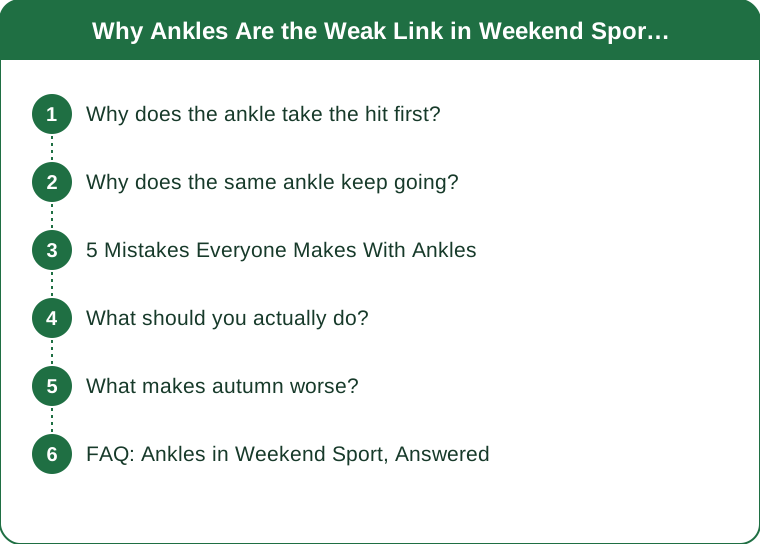
Why does the ankle take the hit first?
The ankle is the first joint to meet the ground, so it absorbs every surface irregularity before anything upstream gets a chance to respond.
Direction changes load it laterally, and the ankle is far stronger front-to-back than side-to-side - which is exactly the wrong orientation for most field and court sports.
A desk week reduces ankle mobility measurably. Sitting keeps the joint in a narrow range for hours, and reduced dorsiflexion changes how you land and cut.
The stabilising response is fast and reflexive, running faster than conscious reaction, and reflexes get slower when they are not trained.
Weekend sport supplies intensity without frequency, which is the worst combination for a joint that depends on a trained reflex.
So the ankle is simultaneously the most exposed joint and the least prepared one, which is why it goes first.
Why does the same ankle keep going?
Ankle sprains damage the ligament and the position sense in the joint, and the second one recovers much more slowly than the first.
Swelling and pain resolve in a couple of weeks; the sense of where the joint is in space takes considerably longer, and it is invisible.
Most people return when it stops hurting, which is why re-injury rates for recreational ankle sprains are so high.
Each re-injury adds a little more laxity and a little less position sense, and the pattern compounds over seasons.
The joint feels fine walking in a straight line and fails on the first unplanned cut, which is why the return-to-sport test needs to include unplanned movement.
If you can balance on that leg with your eyes closed for 30 seconds, the position sense is back. If you cannot, it is not, regardless of how it feels.
5 Mistakes Everyone Makes With Ankles
Treating a sprain as a two-week problem. Pain resolves long before stability does. Balance work should continue for six to eight weeks after the swelling goes, not two.
Relying on tape or a brace instead of training. Both help acutely and neither builds anything. A brace on an untrained ankle is a season-long dependency.
Only warming up in straight lines. Jogging prepares you for jogging. If your sport involves cutting, the warm-up needs to involve cutting - progressively, at increasing speed.
Wearing worn-out shoes for lateral sport. The lateral support in a court or field shoe degrades long before the cushioning looks used. Running shoes for a cutting sport are a separate and larger mistake.
Never doing single-leg work. Everything about your sport happens on one leg, and almost every gym exercise happens on two. That gap is where the weakness lives - and the fifth mistake surprises people, because ten minutes a week closes most of it.

What should you actually do?
Single-leg balance, 30 seconds each side, eyes open then closed. Add it while brushing your teeth and it costs you nothing.
Single-leg calf raises, 3 sets of 12 each side, twice a week. The calf is the ankle’s main active stabiliser and most people are dramatically weaker on one side.
Lateral hops, 2 sets of 10 each direction, landing softly and controlling the stop rather than bouncing.
Ankle circles and controlled dorsiflexion stretches on desk days, since that is where the stiffness accumulates.
A cutting warm-up before you play: five minutes of progressive side-shuffles, changes of direction, and gradually sharper turns.
And check the shoes. Lateral support degrades invisibly - if the upper flexes noticeably when you push sideways on the empty shoe, it is done.
What makes autumn worse?
Autumn fields are softer, wetter and more uneven than the summer ground everyone finished the last season on.
Wet grass changes how the foot releases from the surface - sometimes gripping harder, sometimes sliding - and unpredictable release is what sprains ankles.
Fallen leaves hide surface irregularities completely, and a hidden dip on an unplanned cut is a classic autumn mechanism.
Colder muscles have slower reflexes, so the warm-up needs to be longer than the summer one, not the same length.
Fixtures often restart at full intensity in September after a summer of little play, which is exactly the frequency-intensity mismatch the joint handles worst.
Give yourself three weeks of ramped intensity, add ten minutes of ankle work to your week now, and walk the pitch before the first game on any unfamiliar ground.
FAQ: Ankles in Weekend Sport, Answered
Why do I keep spraining the same ankle?
Position sense in the joint recovers much more slowly than the pain does, and most people return to sport once it stops hurting. The joint feels fine in straight lines and fails on the first unplanned cut.
How long should I stay out after a sprain?
Beyond pain resolution, continue balance work for six to eight weeks. A practical test: 30 seconds of single-leg balance with eyes closed before returning to cutting sport.
Do ankle braces work?
They help acutely and build nothing. Use one while you rebuild strength, not instead of rebuilding it.
What is the single most useful exercise?
Single-leg balance with eyes closed, 30 seconds each side, daily. It costs nothing and directly trains the reflex that fails.
Are running shoes okay for court sport?
No. They are built for forward motion and are unstable laterally, which is the exact direction that sprains ankles.
Why is autumn worse?
Softer, wetter, leaf-covered ground plus colder muscles with slower reflexes, arriving at the same time as a full-intensity fixture restart. This is general information, not medical advice - see a professional for a sprain that is not improving.
TL;DR:
- The ankle is the most exposed joint and the least prepared one - it meets the ground first and is weakest in the exact direction sport loads it.
- Re-injury is common because position sense recovers far more slowly than pain, and most people return once it stops hurting.
- Ten minutes a week fixes most of it: single-leg balance eyes closed, single-leg calf raises, lateral hops.
- Warm up with cutting movements, not just jogging, and check that your shoes still have lateral support.
- Autumn adds soft wet leaf-covered ground and colder, slower reflexes to a full-intensity fixture restart.
Walk unfamiliar ground before the first game. This is general information, not medical advice.
Keep Reading
This article is for general informational and styling purposes only. Fit, sizing, and product availability may vary.