The End-of-Summer Mileage Jump That Wrecks September
Quick Answer: Late August feels like permission to train harder because the temperature drops and effort suddenly feels easier at the same pace. The problem is that your cardiovascular system responds to cool weather immediately while tendons and bones adapt over weeks, so people add distance and intensity at the same time and land in September with achilles, shin, or knee problems. Hold total weekly volume increases to about 10 percent, add either distance or intensity in a given week but never both, and give yourself two easy weeks before any fall event build.

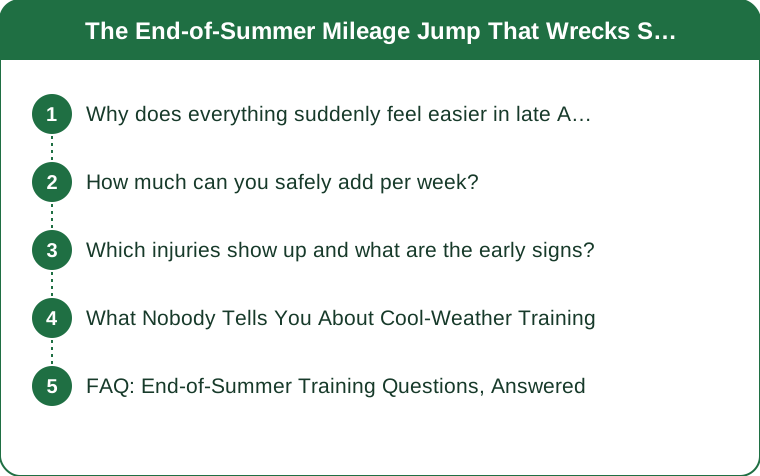
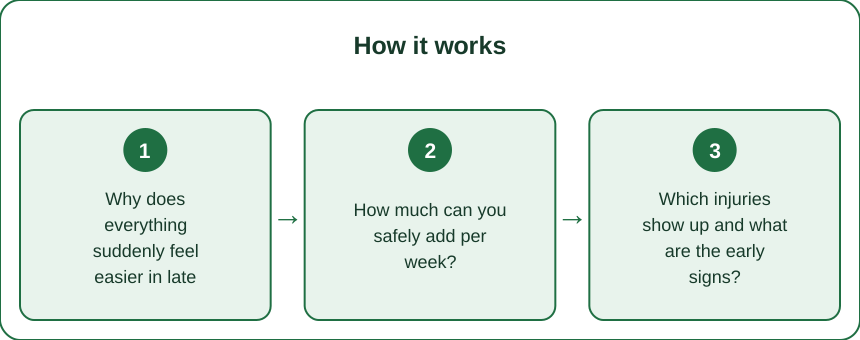
Why does everything suddenly feel easier in late August?
Heat is a massive tax on perceived effort. At 85°F and humid, your body diverts blood to the skin for cooling, your heart rate runs 10 to 20 beats higher at a given pace, and your legs feel heavier than the workload justifies.
Drop the morning temperature to 62°F and all of that reverses in a single session. Same fitness, same legs, dramatically better numbers. It feels like a breakthrough.
Here is the mismatch. Your aerobic system uncovers that capacity instantly. Your tendons, ligaments, and bones have no idea the weather changed. Connective tissue remodels on a timeline of weeks to months, and it adapted to whatever load you were actually doing in July — which, in most cases, was reduced because of the heat.
So you have a summer of lower volume, a sudden feeling of strength, and a calendar full of fall races. That combination is why sports medicine clinics get busy in the second half of September.
How much can you safely add per week?
The old 10 percent rule is imperfect but it is a reasonable ceiling for this specific situation.
Apply it to total weekly volume, not to a single run. Going from 20 to 22 miles across a week is fine. Going from a 6-mile long run to a 10-mile long run while holding weekly total steady is not, because the long run is where tissue stress concentrates.
A cleaner way to think about it: add distance or add intensity in a given week, never both. Cool weather makes both feel available simultaneously, and that is the actual trap.
For weekend-only athletes the math is stricter, because your load is concentrated into two days. If you run 12 miles a week across two sessions, adding two miles is a 17 percent jump on your body’s tissue even though it looks small on paper.
And every fourth week, hold flat or go down. Adaptation happens during the easy weeks, not the hard ones.

Which injuries show up and what are the early signs?
Three dominate the September wave.
Achilles tendinopathy. The tell is stiffness in the first ten steps out of bed that eases as you move. That easing is what fools people — it feels like it is getting better every morning when the tissue is actually accumulating damage. Cooler weather also means less pre-warmed tissue at the start of runs.
Tibial bone stress. A specific, pinpoint ache along the shin that you can cover with one fingertip, worse during and after impact and not relieved by rest days. This one is not a push-through injury. Point tenderness on bone warrants stopping and getting it looked at.
Patellofemoral pain. Vague ache around or behind the kneecap, worse going downhill or down stairs, worse after sitting a while. Usually a volume-and-cadence problem rather than a knee problem.
The common thread: all three are load-tolerance failures, and all three give you two to three weeks of quiet warning signs before they become session-ending. The people who catch them are the ones tracking how they feel in the first ten steps of the morning.
What Nobody Tells You About Cool-Weather Training
Your warm-up needs to get longer as the temperature drops, at the exact moment you feel least like doing one. In August heat you were warm before you started. At 55°F you are not, and tendons are meaningfully stiffer below about 60°F. Add five minutes of walking and easy movement before the first mile.
Your hydration drops without you noticing. You sweat less, so you drink less, but the cool dry air of early fall still pulls significant fluid through breathing. Mild dehydration reduces tissue quality and recovery.
Old shoes hide worse in cool weather. In the heat you notice discomfort quickly. In the cool you are more tolerant, so worn-out midsoles go unreported. If your shoes have 300 to 400 miles on them, the September mileage bump is the worst possible time to keep them.
Downhill running is the sneaky load. Fall routes tend to be hillier because summer routes were flat and shaded. Eccentric downhill loading is far more damaging than uphill, and nobody counts it as intensity.
Your fitness did not actually jump. It was always there, hidden under the heat. Treating it as new fitness is what causes the overshoot.
FAQ: End-of-Summer Training Questions, Answered
I feel great — why should I hold back?
Because the feeling is real and the tissue readiness is not. Cardiovascular capacity and connective tissue tolerance run on completely different timelines, and the gap between them in late August is at its widest point of the year.
How do I build for an October race then?
Start the build now but conservatively, with 10 percent weekly increases and a down week every fourth week. Eight weeks of consistent building beats four weeks of aggressive building followed by four weeks of injury, and the math on that is not close.
Is soreness the same as a warning sign?
No. General muscle soreness spread across a muscle group and fading in two days is normal adaptation. Sharp, localized, one-sided pain at a joint or along a bone is not. This is general information, not medical advice — persistent localized pain deserves a professional look.
Should weekend-only athletes add a midweek session in the fall?
If you can, yes. Adding one short easy midweek run distributes load better than making the weekend sessions longer, and it is one of the most protective changes a weekend athlete can make.
TL;DR:
- Cool weather reveals fitness that was already there — it does not create new tissue tolerance.
- Cap weekly volume increases at about 10 percent, and add distance or intensity, never both in the same week.
- Take a down week every fourth week; adaptation happens there, not in the hard weeks.
- Watch three early signs: morning achilles stiffness, pinpoint shin tenderness, and downhill knee ache.
- Lengthen your warm-up as temperatures fall, and replace shoes past 300 to 400 miles before the build, not during it.
The best September you can have starts with a slightly boring late August. Bank the enthusiasm, spend it over eight weeks instead of two, and you will be the one still running when everyone else is in physical therapy.
Keep Reading
This article is for general informational and styling purposes only. Fit, sizing, and product availability may vary.