Why the Third Big Weekend in a Row Is the One That Breaks You
Quick Answer: Weekend-only training concentrates a week’s load into two days, and tissue adaptation runs on a slower clock than fitness does. Muscle recovers in days; tendon and bone adapt over weeks. Three consecutive high-load weekends usually exceeds the connective tissue’s ability to keep up, which is why problems appear on the third rather than the first. Alternate a lighter weekend every third one, and add one short weekday session to spread the load.
It is not that you are getting less fit. The tissue timeline is simply longer than the fitness timeline.
We have covered the Monday-Tuesday buffer, single-session volume caps and single-day versus spread-out training. This is the multi-week version of the same arithmetic.

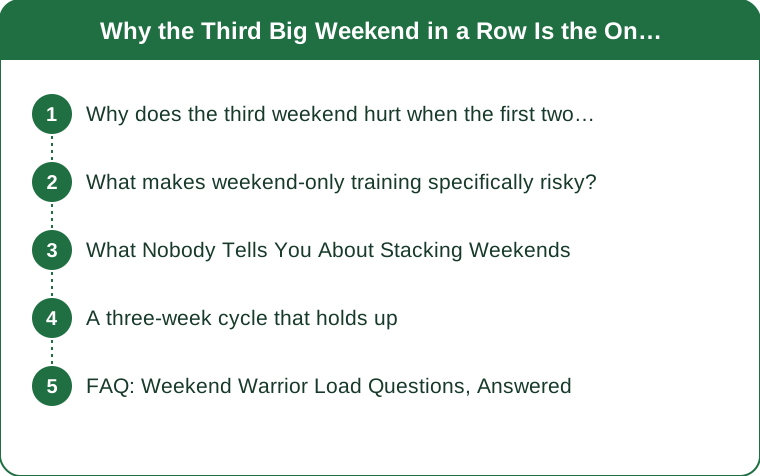
Why does the third weekend hurt when the first two did not?
Because different tissues recover at completely different speeds.
Muscle recovers fast. Most of the soreness and force loss from a hard weekend resolves within two to four days, which is why the following Saturday feels fine.
Tendon turnover is far slower. Collagen synthesis rises after loading and stays elevated for a couple of days, but net remodelling takes weeks, and there is a window where breakdown exceeds synthesis.
Bone adapts slower still. Bone remodelling operates over weeks to months, and stress reactions develop from repeated loading that outpaces it.
Which produces a mismatch. Muscle says ready, connective tissue is still catching up, and you feel fine going into a session that the tendon is not prepared for.
The deficit accumulates. Each weekend adds a little more than gets repaired, and three cycles is roughly where the gap becomes symptomatic for most people.
And the symptom is characteristic. Not acute pain during the session, but a stiffness that takes longer to warm out each time, and a Monday that no longer clears by Wednesday.
What makes weekend-only training specifically risky?
Density, not volume. The total may be reasonable; the distribution is not.
Five days off means detraining between exposures. Tendon stiffness and neuromuscular coordination both drift down across a sedentary week, so each Saturday you are slightly less prepared than you finished the previous Sunday.
Then you apply the full load anyway. A four-hour hike or a long ride is the same demand whether you did anything on Wednesday or not.
The first hour is where most of the damage happens. Coming in cold from five sedentary days, tissue tolerance is at its lowest exactly when enthusiasm is highest.
Two consecutive days compound it. Sunday starts from an already-fatigued baseline, and fatigued movement patterns load tissue differently.
Seasonal timing sharpens it. Late summer and early autumn are when many people stack big weekends before the weather turns, which is exactly the pattern that produces October injuries.
And the research is genuinely encouraging on the health side. Weekend warrior patterns show similar cardiovascular benefit to spread-out training. The caveat is musculoskeletal, not cardiovascular.

What Nobody Tells You About Stacking Weekends
Fitness improves faster than tolerance. Your cardiovascular system adapts in weeks, which means you can comfortably do more than your tendons are ready for. That gap is the injury.
The warning sign is warmup duration, not pain. If it takes twenty minutes to feel normal when it used to take five, load has outrun recovery. That is the signal to take an easier weekend, and it appears before anything hurts.
Sleep on the intervening weekdays matters more than the weekend’s. Collagen synthesis and repair are happening Tuesday through Thursday, and a bad sleep week undermines the recovery that the whole pattern depends on.
One short weekday session changes the picture disproportionately. Even twenty or thirty minutes of the same movement pattern midweek keeps tendon and neuromuscular preparation from decaying, and it is the highest-value change most weekend athletes can make.
Deload weekends do not need to be rest weekends. Half the duration at the same intensity, or the same duration much easier, both work. Complete rest is not required and often is not what people will actually do.
And two easy weekends in a row is not weakness. The cycle that works long term for most weekend athletes is two hard, one easy, repeating.
One caution: pain that is sharp, localised and worse with each session, or that appears at rest, is a different category. That warrants assessment rather than a lighter weekend. This is general information, not medical advice.
A three-week cycle that holds up
Six rules that keep the pattern sustainable.
Plan in three-week blocks: hard, hard, easy. Decide the easy weekend in advance rather than waiting for something to hurt, because by then you have already paid for it.
Cap the jump between weekends at about ten percent. A four-hour hike followed by a seven-hour one is where a lot of trouble starts, regardless of how the four hours felt.
Add one short midweek session. Thirty minutes, same movement pattern, easy intensity. This is the intervention with the best return.
Make Sunday the shorter day, not the longer one. Starting the second day already fatigued and then extending it is the most common way weekends escalate.
Track how long the warmup takes. It is a better early indicator than soreness and it costs nothing to notice.
And front-load the season. If you know autumn weather will compress your outdoor weekends, build the easy weekends in now rather than trying to cram in three big ones before the clocks change.
One scheduling note as daylight shrinks: shorter days push weekend activities into a narrower window, which tempts people into two long days instead of a long one and a short one. Deciding the shape of the weekend on Thursday protects you from Saturday’s optimism.
FAQ: Weekend Warrior Load Questions, Answered
Is weekend-only exercise bad for you?
No. Research consistently finds similar cardiovascular and mortality benefits for weekend-concentrated activity compared with spread-out activity at the same total volume. The trade-off is musculoskeletal: concentrated loading with five sedentary days between raises overuse injury risk.
How many hard weekends in a row is too many?
For most people, three is where problems start appearing. A hard, hard, easy cycle in three-week blocks is a reliable structure. The easy weekend can be half the duration or the same duration much easier, and does not need to be complete rest.
What is the single best change if I can only make one?
Add one short weekday session in the same movement pattern. Even twenty to thirty minutes maintains tendon preparation and coordination through the week, so Saturday does not start from a detrained baseline.
TL;DR:
- Muscle recovers in days; tendon and bone adapt over weeks. That mismatch is why weekend three hurts.
- Five sedentary days mean each weekend starts slightly less prepared than the last one ended.
- Run three-week blocks: hard, hard, easy, planned in advance rather than triggered by pain.
- Warmup duration creeping up is your earliest warning, well before anything actually hurts.
The fix is not less ambition. It is one short weekday session and a planned easy weekend every third one.
Keep Reading
This article is for general informational and styling purposes only. Fit, sizing, and product availability may vary.