Why a Saturday Hike Leaves You Sore in Places Your Training Never Touches
Quick Answer: Descending a hill loads your quadriceps eccentrically — the muscle lengthens while producing force to control your body weight down each step. Eccentric contractions cause substantially more muscle damage and delayed soreness than the concentric work that makes up most gym training, which is why a hike leaves you sore in a way that squats at the same effort do not. The soreness peaks 24 to 48 hours later, and it is largely preventable with gradual exposure, poles, and shorter steps.
Uphill costs your lungs. Downhill costs your legs for three days.
What is different about walking downhill?
Your muscles are working while getting longer, and that is a different kind of load.
Going uphill, your quadriceps shorten as they produce force — a concentric contraction. It is metabolically expensive, your heart rate climbs, and it feels hard at the time.
Going downhill, the same muscles lengthen while producing force to control your descent. That is an eccentric contraction, and it is the one that causes muscle damage.
Eccentric contractions produce far more delayed onset muscle soreness than concentric work at the same load. The mechanism involves microscopic damage to muscle fibres and connective tissue, followed by an inflammatory response over the following days.
They also feel deceptively easy. Eccentric work uses less oxygen and produces a lower heart rate than concentric work at the same force. The descent feels like the easy part, which is exactly why people do too much of it.
Each step down is an impact absorbed by the quads. On a long descent that is thousands of repetitions of a loaded lengthening contraction, at bodyweight plus pack, on uneven ground.
Which is why the soreness pattern is so specific: front of the thighs, and calves, and worst going down stairs — because descending stairs uses the same eccentric action on already-damaged muscle.
Why does the soreness arrive a day later?
Because the damage response takes time to develop.
Delayed onset muscle soreness typically begins several hours after the activity, peaks between 24 and 72 hours, and resolves within about a week. You often feel fine on the drive home and terrible on Monday morning.
It is not lactic acid. Lactate clears within an hour of exercise finishing and has nothing to do with soreness two days later. This myth is unusually persistent and it leads people to try remedies that address the wrong thing entirely.
The soreness comes with real, temporary loss of function. Strength is reduced, range of motion is reduced, and coordination is slightly impaired for a few days. That is why the second hike of a back-to-back weekend has a genuinely higher injury risk.
There is a strong protective effect from repetition. The repeated bout effect means the same descent done again within a few weeks produces markedly less soreness, and the protection lasts for weeks to months. This is why regular hikers stop getting wrecked and occasional hikers never do.
Which is exactly the weekend warrior trap. Doing one big hike every few months means you never build the protective adaptation, so every hike costs you the full three-day recovery.
Downhill running produces the same effect more intensely, which is why a trail race with significant descent leaves people sorer than a flat marathon.
5 Mistakes on the Descent
1. Treating the way down as recovery. It feels easy and it is doing most of the damage. Pace and manage the descent deliberately rather than letting gravity take over because the hard part is over.
2. Long strides down steep ground. A long step means a bigger drop, a harder landing, and a larger eccentric load on one leg. Shorter, quicker steps distribute the same descent across more, smaller contractions and are also considerably safer.
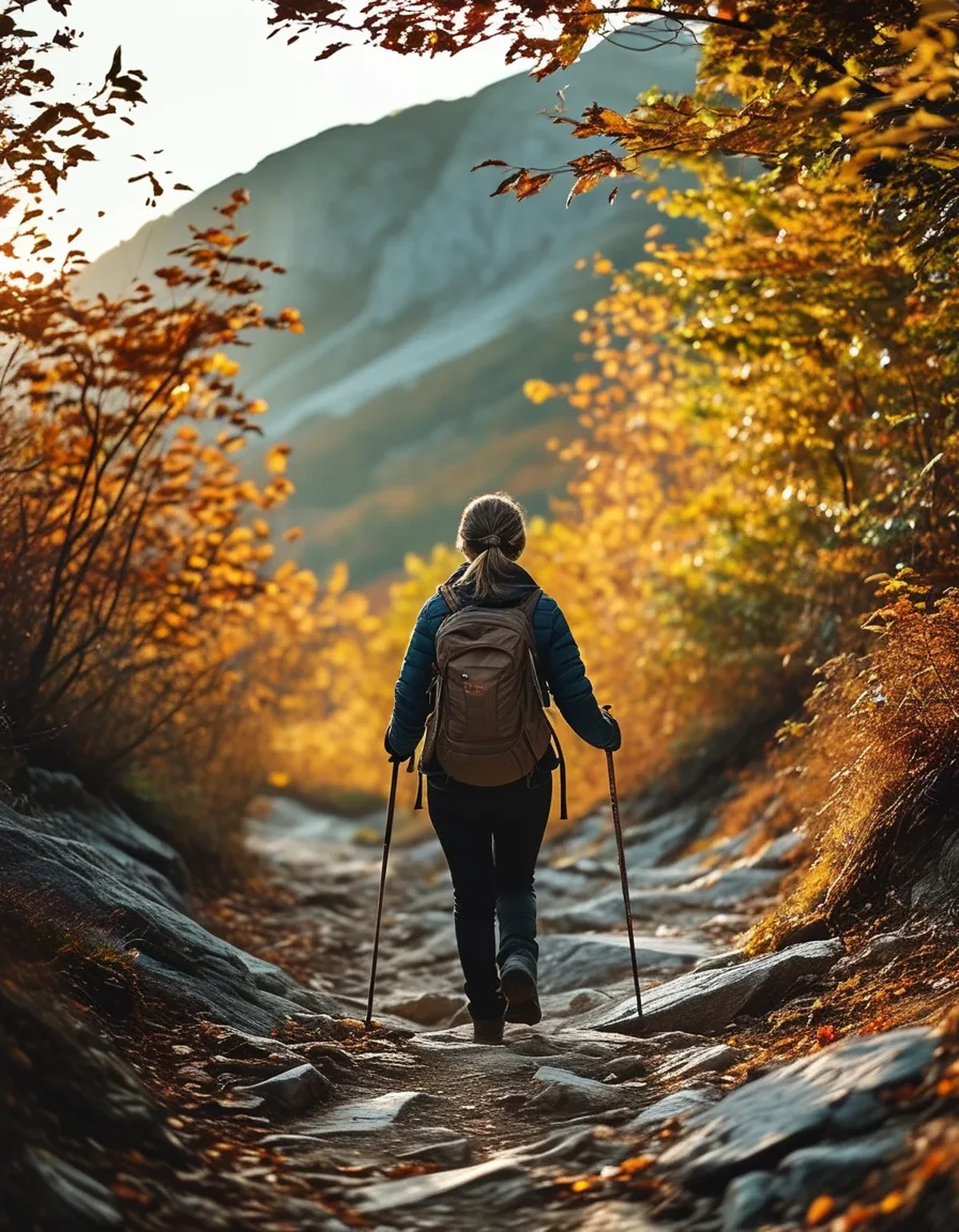
3. Leaving the poles in the pack. Trekking poles meaningfully reduce loading on the legs during descent by transferring force through the arms. They are far more useful going down than going up, which is the reverse of how most people use them.
4. Jumping into a big descent unprepared. The first significant hike of autumn after a flat summer is where this bites hardest. Build up over a few outings rather than making the first one the biggest.
5. Planning something demanding the next day. With reduced strength and coordination for 48 hours, Sunday after a big Saturday descent is a poor day for anything technical or fast.
How do you prepare for and recover from a big descent?
Train eccentrically beforehand. Manage load on the day. Move gently afterwards.
Before, in the weeks leading up:
Include eccentric-focused leg work. Slow lowering phases on squats and split squats — three to four seconds down — is the specific preparation for downhill hiking, and it produces the repeated bout protection without a mountain.
Step-downs are the closest gym match. Standing on a step, lower slowly to the floor with control on one leg. Two to three sets of 8 to 10 per leg, twice a week, for a few weeks before a big hike.
Do some actual descending. Stairs, a local hill, anything with genuine downhill. Specificity matters and there is no substitute.
On the day:
Use poles on every descent. Set slightly longer than for climbing.
Shorten your stride and increase cadence on steep ground, keeping a soft knee rather than landing on a locked leg.
Take the descent in sections with short pauses. Continuous long descents accumulate damage without relief.
Keep the pack as light as sensible. Every kilogram adds to every single eccentric contraction on the way down.
Afterwards:
Walk gently the next day. Light movement reduces the stiffness of DOMS, whereas complete rest tends to make it feel worse.
Eat properly, including protein, and sleep, which are the two things that actually support repair.
Accept that it takes a few days. Massage, cold, and heat may make it feel better temporarily; nothing meaningfully accelerates the repair itself.
Know the difference between soreness and injury. DOMS is symmetrical, diffuse, worst at 24 to 48 hours, and improving by day four. Sharp, one-sided, localised pain, swelling, or pain that worsens after day three is something else and worth getting checked.
One serious note: severe muscle pain with dark or cola-coloured urine after unaccustomed intense exercise needs urgent medical attention. It is rare, and it is an emergency.
This is general information, not medical advice.
FAQ: Downhill Hiking Soreness, Answered
Why are my quads sore but not my glutes after a hike?
Because the descent loads the quadriceps eccentrically thousands of times to control each step down, and eccentric work causes far more muscle damage than the concentric climbing that recruits your glutes.
Is it lactic acid?
No. Lactate clears within about an hour of finishing. Soreness peaking a day or two later comes from microscopic muscle damage and the inflammatory repair response.
How do I stop it happening next time?
Build the repeated bout effect with slow-lowering strength work and regular smaller descents in the weeks beforehand. Then use poles, shorten your stride, and keep the pack light on the day.
Should I rest completely until the soreness goes?
Gentle movement generally reduces stiffness more than complete rest does. Save anything hard, fast, or technical until strength and coordination return, which takes a couple of days.
TL;DR:
- Descending loads the quads eccentrically, and eccentric contractions cause far more muscle damage than the climb does.
- Downhill feels easy because it uses less oxygen, which is exactly why people overdo it.
- Soreness peaks 24 to 48 hours later with real temporary strength loss, making back-to-back big days riskier.
- Slow-lowering strength work, poles, shorter strides, and a lighter pack are the four things that actually prevent it.
Add step-downs twice a week for three weeks before your next big hike. That one change is worth more than anything you do on the trail.
Keep Reading
This article is for general informational and styling purposes only. Fit, sizing, and product availability may vary.