Does a Cold Plunge Actually Help Weekend Warrior Monday Soreness?
Quick Answer: Cold exposure (10-15 minutes at 50-59°F) taken within a few hours after intense weekend activity can measurably reduce inflammation markers and perceived soreness by Monday, though timing it too close to strength-focused sessions may slightly blunt long-term muscle adaptation.
You push hard on Saturday, feel fine Saturday night, and wake up Monday barely able to sit down. A cold plunge won’t undo the weekend, but done right, it takes real edge off the crash that follows.

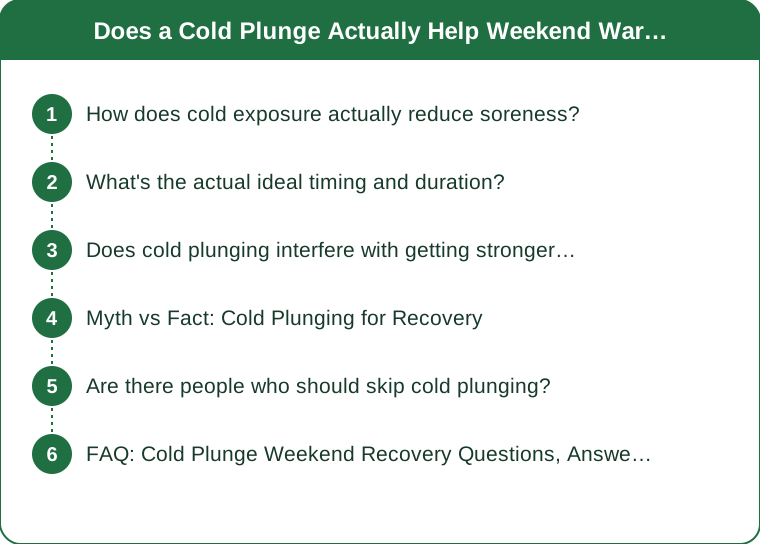
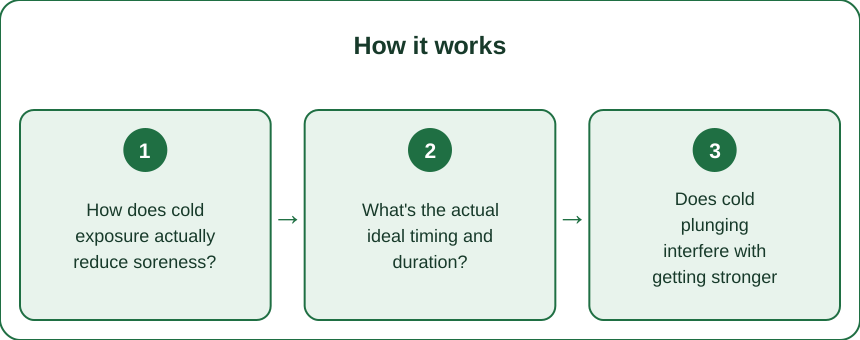
How does cold exposure actually reduce soreness?
Cold water immersion causes blood vessels to constrict, which reduces blood flow and swelling to worked muscle tissue in the hours immediately following intense exercise. When you warm back up afterward, blood flow returns in a rush, which some research suggests helps flush out some of the inflammatory byproducts that contribute to delayed-onset muscle soreness (DOMS).
The effect isn’t about preventing soreness entirely — hard weekend efforts will still produce some — but research on cold water immersion consistently shows a modest reduction in perceived soreness intensity compared to no intervention, particularly for high-impact or high-volume activities.
What’s the actual ideal timing and duration?
Within a few hours of the activity, for 10-15 minutes at 50-59°F, is the range most commonly used in research showing soreness benefits. Colder isn’t necessarily better — extremely cold, very short dips are more about tolerance-building than measurable recovery benefit, and can add unnecessary discomfort without added recovery payoff.
Does cold plunging interfere with getting stronger over time?
This is where it gets nuanced — some research suggests cold water immersion immediately after strength training may slightly blunt the muscle-building adaptation signal, since the same inflammatory response the cold reduces is also part of what triggers muscle repair and growth. For weekend warriors whose goal is feeling functional on Monday rather than maximizing strength gains from that specific session, this tradeoff is usually a reasonable one to accept.

Myth vs Fact: Cold Plunging for Recovery
Myth: Cold plunging prevents soreness entirely. Fact: it reduces perceived soreness intensity, not eliminates it — expect noticeably less discomfort, not none.
Myth: Longer cold exposure always means better recovery. Fact: benefits plateau around 10-15 minutes, and pushing much longer mainly adds cold-stress risk without added recovery value.
Myth: You need an expensive cold plunge tub to get the benefit. Fact: a cold shower, a tub filled with ice and water, or a cold natural body of water all work through the same mechanism — the tub is convenience, not a requirement.
Are there people who should skip cold plunging?
Yes — anyone with cardiovascular conditions, Raynaud’s syndrome, or who becomes lightheaded in cold water should approach cold immersion cautiously or skip it, since the vasoconstriction effect that helps soreness also stresses the cardiovascular system. Pregnant individuals and anyone with cold sensitivity conditions should check with a doctor before starting a cold plunge routine specifically for recovery purposes.
FAQ: Cold Plunge Weekend Recovery Questions, Answered
Is a cold plunge better than just resting for weekend warrior recovery?
Both help, and they’re not mutually exclusive — cold plunging addresses the inflammatory/soreness side, while adequate sleep and light movement address broader recovery, and combining them tends to work better than either alone.
Should I cold plunge before or after stretching post-workout?
After — stretching cold, constricted muscle tissue is less effective and slightly increases strain risk; let the body return to a more normal state first, or stretch beforehand instead.
Does contrast therapy (alternating hot and cold) work better than cold alone?
Some evidence suggests contrast therapy may offer additional circulation benefits, though the research is less conclusive than for cold immersion alone — it’s a reasonable experiment but not a clearly superior default.
TL;DR:
- Cold exposure reduces inflammation and perceived soreness, particularly after high-impact weekend activity
- 10-15 minutes at 50-59°F, within a few hours post-activity, is the evidence-backed range
- It may slightly blunt strength adaptation, a fair tradeoff for weekend-warrior recovery goals
- Skip or approach cautiously with cardiovascular conditions or cold sensitivity
A cold plunge isn’t a magic Monday fix, but it’s one of the few recovery tools with real evidence behind it for exactly the kind of soreness a hard weekend leaves behind.
Keep Reading
This article is for general informational and styling purposes only. Fit, sizing, and product availability may vary.