Normal Soreness or Injury Red Flag? A Weekend Warrior's Guide
Quick Answer: Normal post-weekend soreness is symmetric, improves day by day, and doesn’t affect joint function — sharp, one-sided pain, swelling, or soreness that worsens rather than improves after 48-72 hours are red flags that warrant rest and, if persistent, a medical evaluation.
Weekend warriors live in the gap between two workweeks of sitting and one huge burst of activity, which makes soreness a constant companion — but not all soreness is the same, and knowing the difference matters.

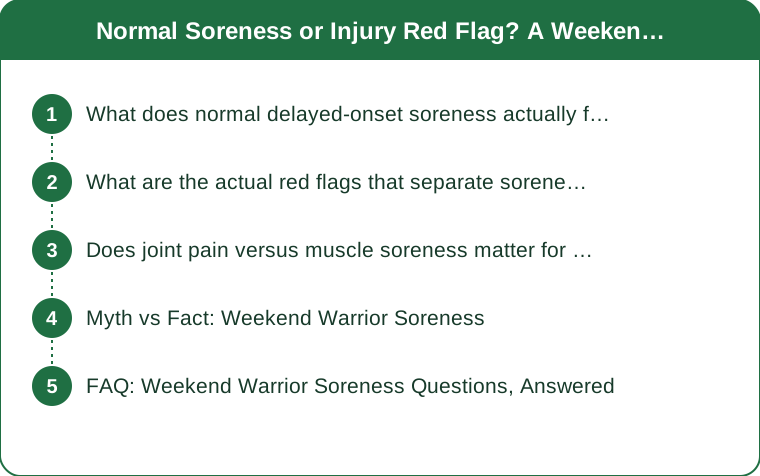
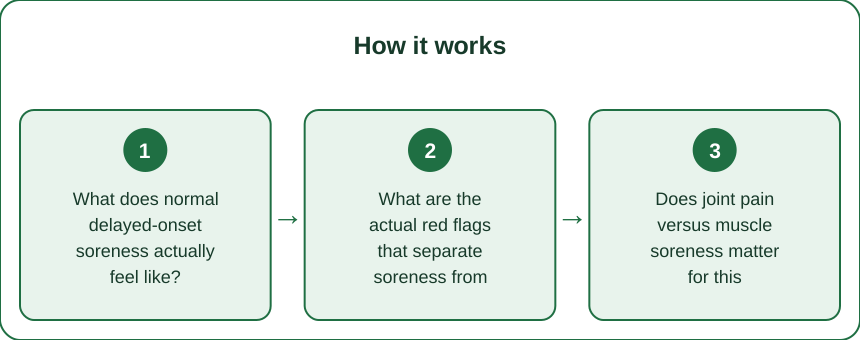
What does normal delayed-onset soreness actually feel like?
Diffuse, symmetric muscle ache that peaks around 24-48 hours after activity and then steadily improves — it should feel like dull tightness or fatigue in the muscle belly, not a sharp point of pain, and it typically doesn’t restrict your basic range of motion, just makes it uncomfortable.
What are the actual red flags that separate soreness from injury?
Sharp, localized pain at a specific point (rather than a general muscle ache), swelling, bruising that appears without a clear impact, pain that’s worse on one side than the other for a symmetric activity, or soreness that gets worse instead of better after 3 days — any of these warrant backing off and paying closer attention.

Does joint pain versus muscle soreness matter for this distinction?
Significantly — muscle soreness is expected after hard effort; joint pain generally is not. A knee, shoulder, or ankle that hurts during specific movements (not just generally tired) is a different category of signal than tired quads after a long hike, and deserves more caution.
Myth vs Fact: Weekend Warrior Soreness
Myth: No pain, no gain — you should push through any discomfort. Fact: Pushing through sharp or localized pain (versus general muscle fatigue) is how minor strains become serious injuries. The distinction matters more than the intensity of your effort.
Myth: Soreness that lasts a full week is just because you’re out of shape. Fact: Normal soreness resolving within 2-4 days is typical even for deconditioned muscles — soreness persisting a full week or longer is worth evaluating rather than assuming it’s just fitness level.
FAQ: Weekend Warrior Soreness Questions, Answered
How long should normal soreness realistically last?
Most delayed-onset soreness peaks at 24-48 hours and clearly improves by day 3-4 — full resolution by day 5-7 is typical even after a genuinely hard session.
Should I exercise again if I’m still sore from the weekend?
Light movement (walking, easy mobility work) is generally fine and can even help circulation, but avoid repeating high-intensity effort on the same muscle groups until soreness has clearly started improving.
When should I actually see a doctor about post-workout pain?
If you notice significant swelling, pain that worsens rather than improves after 48-72 hours, or pain that affects basic daily function like walking or lifting your arm, that’s worth a professional evaluation. This is general information, not medical advice.
TL;DR:
- Normal soreness is symmetric, diffuse, and improves steadily day by day
- Sharp localized pain, swelling, or one-sided pain are red flags worth attention
- Joint pain is a different category from muscle soreness and deserves more caution
- Pain that worsens rather than improves after 48-72 hours warrants a professional evaluation
Keep Reading
This article is for general informational and styling purposes only. Fit, sizing, and product availability may vary.