Why Sunday Is the Wrong Day for Your Long Session
Quick Answer: Delayed onset muscle soreness peaks 24 to 72 hours after a session, so a Sunday long effort lands its worst day squarely on Monday or Tuesday - your least flexible days. Moving it to Saturday puts the peak on Sunday or Monday, with a rest day available on Sunday to help. Saturday also gives you a recovery walk on Sunday, which measurably reduces soreness. The one thing you should not do is put your hardest session immediately before your busiest morning.
Here is the reasoning and how to restructure the weekend.

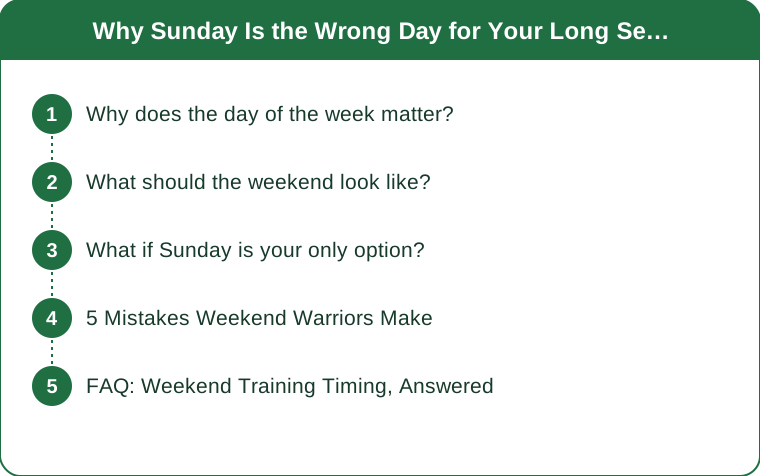
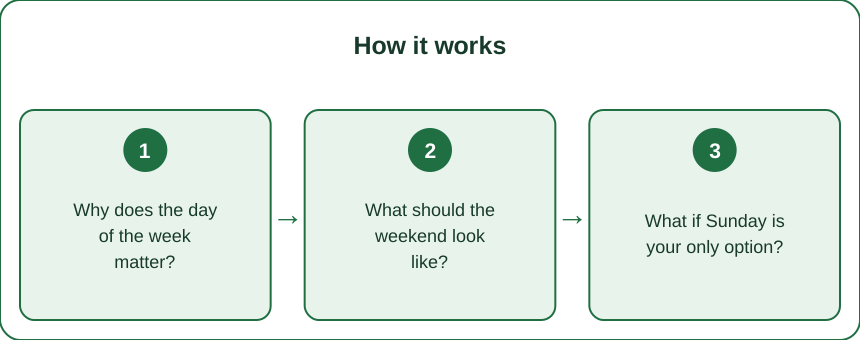
Why does the day of the week matter?
Delayed onset muscle soreness peaks 24 to 72 hours after the session, not immediately. A Sunday morning effort peaks somewhere between Monday morning and Wednesday - exactly the window with the least room for it.
Saturday shifts the whole curve forward a day. The peak lands Sunday to Tuesday, with Sunday available as an active recovery day, which is a materially better arrangement.
Active recovery genuinely reduces soreness. A 20 to 30 minute easy walk the day after improves circulation to recovering tissue and reduces stiffness measurably - and Saturday sessions leave Sunday free for exactly that.
Monday stiffness has knock-on effects. Sore legs on Monday change how you sit, walk, and move all day, and for people who commute or stand at work that is a real cost.
Sleep quality after a hard session matters too. A Sunday evening after a hard morning is frequently poor sleep, and Sunday night is the night people least want to lose.
And Saturday sessions have a practical advantage: if something goes wrong - weather, a niggle, a late start - Sunday is available as a backup. A Sunday session has no fallback at all.
What should the weekend look like?
Saturday morning: the long or hard session. Ideally earlier rather than later, so there is a full day of eating and moving afterwards before you sleep.
Saturday afternoon: eat properly and move gently. Protein within a few hours and carbohydrate to replace glycogen matters more after a long effort than most weekend athletes assume.
Sunday: active recovery. A 20 to 40 minute easy walk, swim, or gentle cycle at genuinely easy effort. Not a second session - the aim is circulation, not training.
Sunday evening: prioritise sleep. This is where the actual recovery happens, and protecting Sunday night is worth more than any supplement.
Add a short weekday session on Wednesday. Weekend warriors improve most by adding one midweek session, which spreads the load and reduces the size of the weekend jump.
Keep the Saturday session under about a 10 percent increase week to week. The characteristic weekend warrior injury pattern comes from large jumps made possible by having a whole free morning.
And warm up properly, for 10 to 15 minutes. Going from five sedentary days straight into the hardest session of the week is the highest-risk moment in the whole schedule.

What if Sunday is your only option?
Then shorten the session and reduce the intensity slightly. A Sunday session at 80 percent of the planned volume produces far less Monday disruption for a modest reduction in training.
Do it early in the day. A Sunday morning session leaves the whole day for eating, moving, and recovering before Monday, whereas a late afternoon one does not.
Walk for 15 minutes on Sunday evening. Even a short easy walk hours after the session reduces next-day stiffness noticeably.
Eat and hydrate deliberately afterwards. Underfuelling after a long Sunday is a substantial contributor to how bad Monday feels, and it is entirely avoidable.
Avoid eccentric-heavy work on Sundays specifically. Downhill running, heavy lowering, and plyometrics produce the most soreness - save those for Saturdays and keep Sunday sessions steadier.
Build the habit gradually. The soreness response reduces substantially after the first two or three exposures to a given session - the repeated bout effect - so consistency reduces the Monday problem on its own.
And take Monday as a genuine rest day rather than trying to train through it. Persistent pain, as distinct from soreness, deserves proper assessment - this is general information, not medical advice.
5 Mistakes Weekend Warriors Make
1. Putting the hardest session immediately before the busiest day. Soreness peaks at 24 to 72 hours, which puts a Sunday session squarely into Monday and Tuesday.
2. Doing nothing on the other day. A complete rest day after a long session is worse than an easy walk for stiffness. Active recovery is the better use of Sunday.
3. Jumping volume because the time is available. A free Saturday morning invites a session much larger than the week supports. Cap increases at about 10 percent.
4. Skipping the warm-up. Going from five sedentary days into the week’s hardest session is the single riskiest moment, and it deserves 10 to 15 minutes.
5. Training only at weekends. One midweek session changes the picture more than anything else - it reduces the size of the weekend jump and improves everything about how the weekend feels.
The theme is that the weekend is a schedule, not just a session. Which day, what happens the day after, and whether anything happens midweek matter as much as the session itself - and all three are free to change.
FAQ: Weekend Training Timing, Answered
Should I do my long session on Saturday or Sunday?
Saturday, if you can. Soreness peaks 24 to 72 hours later, so Saturday puts the worst of it on Sunday and Monday with a recovery day available, rather than on Monday and Tuesday.
When does soreness actually peak?
Usually 24 to 72 hours after the session, which is why the day you train determines which weekday you feel worst.
Is complete rest the best recovery?
No. A 20 to 40 minute easy walk or gentle cycle the day after reduces stiffness measurably more than doing nothing.
What if I can only train on Sunday?
Go early, cut volume to around 80 percent, avoid eccentric-heavy work, walk for 15 minutes that evening, and eat properly afterwards.
How much should I increase week to week?
Around 10 percent. A free weekend morning makes much larger jumps possible, and that is the classic weekend warrior injury pattern.
Does one midweek session really help?
Substantially. It spreads the load, reduces the size of the weekend jump, and improves how the weekend session itself feels.
Why is my second time doing a session so much less sore?
The repeated bout effect - your muscles adapt quickly to a specific type of loading. Consistency reduces soreness on its own. Persistent pain rather than soreness deserves proper assessment.
TL;DR:
- Soreness peaks 24 to 72 hours later, so a Sunday session lands on Monday and Tuesday - your least flexible days.
- Saturday morning for the long session, Sunday for 20 to 40 minutes of genuine active recovery.
- Active recovery beats complete rest for stiffness.
- Add one midweek session - it reduces the size of the weekend jump more than any other change.
- Cap week-to-week increases at about 10 percent. A free morning invites too-large jumps.
- Warm up for 10 to 15 minutes - five sedentary days into the hardest session is the riskiest moment of the week.
- If Sunday is unavoidable: go early, 80 percent volume, no eccentric-heavy work, walk that evening.
The weekend is a schedule, not a session. Persistent pain rather than soreness deserves proper assessment.
Keep Reading
This article is for general informational and styling purposes only. Fit, sizing, and product availability may vary.