Losing Daylight Is About to Wreck Your Training Week — Plan For It Now
Quick Answer: From late August through October you lose roughly two to three minutes of evening daylight per day — around an hour and a half of usable evening light over six weeks. For weekend warriors, that quietly deletes weekday sessions and pushes even more load onto Saturday and Sunday, which is exactly the pattern that produces October injuries. Decide now which sessions move to mornings, which move indoors, and which get lit.
Right now the light still holds until nearly eight. In six weeks it will be gone by six thirty, and you will be standing in your kitchen at 6:15pm deciding not to go out.
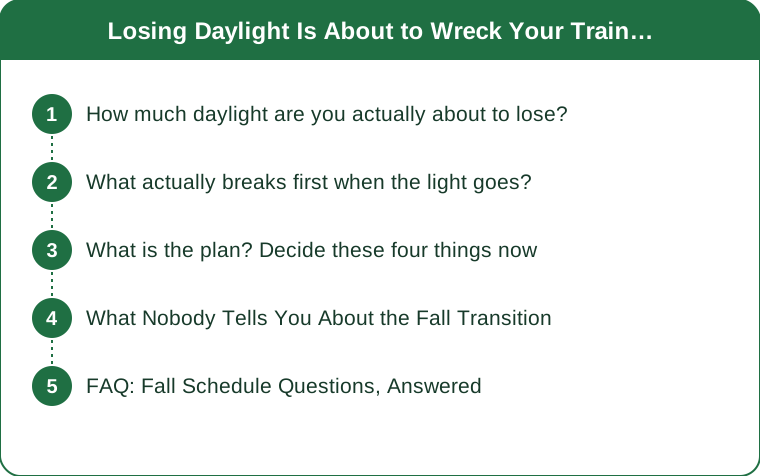
The failure mode is not laziness — it is a schedule that stops working and never gets redesigned. The third section is the plan.

How much daylight are you actually about to lose?
More than most people budget for, and the rate is not constant.
Around the equinox in late September, daylight loss is at its fastest — roughly two to three minutes per day in the mid-latitudes of the US, which is where the change becomes noticeable week to week rather than month to month.
Practically, across the six weeks from mid-August to the end of September, most US locations lose somewhere in the region of 80 to 100 minutes of evening light. Then the clock change in early November removes another chunk from the evening in one step.
The asymmetry matters: you gain a little morning light while losing evening light, and then the clock change flips that abruptly. For anyone whose training is in the evening, the losses arrive continuously and the compensation arrives all at once, in the wrong direction.
Why this hits weekend warriors specifically: the weekend warrior pattern already concentrates load into two days. Research on weekend warriors has found that concentrating physical activity into one or two sessions still delivers substantial health benefits — the pattern is not the problem. The problem is when the two supporting weekday sessions disappear and the weekend load stays the same or grows.
That combination — less weekday preparation, unchanged weekend intensity — is the specific setup that produces the October calf strain.
What actually breaks first when the light goes?
A predictable sequence, and knowing it lets you defend the right thing.
First to go: the Tuesday or Wednesday evening session. It was always the least protected, and it is the first one that requires a headlamp or a treadmill. This is the session that maintains the movement patterns your weekend depends on.
Second: outdoor skill and speed work. Anything requiring visibility — trail running, technical riding, field sports, anything with footing consequences. People substitute steady indoor cardio, which maintains fitness and does not maintain agility.
Third: the pre-weekend prep session. Friday’s easy shakeout, the mobility work, the thing that made Saturday go well.
What does not shrink: Saturday. The long ride, the hike, the pickup game, the ambitious project. Weekend ambition is set by mood and weather, not by weekday preparation — which is the whole problem.
So the net effect by mid-October is: less weekly volume, less movement variety, the same or greater weekend peak, on legs that have done less in between. That is a bigger single-session jump relative to weekly baseline than you were making in July, which is the actual injury mechanism.
The single most useful thing you can do is protect one weekday session — even a short one. Not for fitness, for continuity.

What is the plan? Decide these four things now
Do this while the light is still good, because you will not redesign a schedule in the dark.
Decision 1: Which one weekday session is non-negotiable, and where does it live?
Pick one. Move it to a morning if your evening is the constrained one, or accept that it becomes an indoor session. A 25-minute session that happens beats a 60-minute one that does not. Put it in your calendar as an appointment now.
Decision 2: What is your lit option?
Buy the headlamp in August, not in October. A decent running headlamp plus a reflective vest converts an impossible evening into a normal one, and the reason people do not have them is that they are bought in a moment of frustration in the dark rather than planned for. If you run or ride on roads, lights and reflective gear are a safety requirement, not an upgrade. Check that bike lights still hold a charge before you need them.
Decision 3: What replaces the outdoor skill work?
If your sport has an agility component, find the indoor substitute now — a court booking, a gym slot, a class. These fill up in September precisely because everyone has this realization at the same time.
Decision 4: What is the weekend cap?
Set a rule now for the maximum single-session jump you will allow relative to your recent weekly volume. A common guideline is that a long session should not wildly exceed what you have been doing — and when weekday volume drops, that ceiling drops too. Write the number down while you are being sensible about it.
What Nobody Tells You About the Fall Transition
Morning training is more available than it feels. You are losing evening light and gaining a small amount of morning light before the clock change. For six weeks, a 6:45am start is actually getting easier, and it is the only slot that stays viable all winter. The people who move a session to mornings in September are the ones still training in January.
Your body takes about two weeks to adjust to an earlier start, and the adjustment is far easier while the mornings are still mild. Doing it in November is genuinely harder.
Cooler weather makes you feel fitter than you are. The first cool weekend after a humid summer produces a rash of ambitious efforts, because everything feels easy at 15 degrees compared to 28. That is a temperature effect, not a fitness gain, and it is a classic setup for going too hard on a day that felt effortless.
Warm-ups need to get longer again. All summer you have been starting sessions already warm. A cool morning needs the full general warm-up back, and the first cold-morning session of the year is one of the most reliable dates for a strain.
Motivation dips for reasons other than discipline. Reduced light exposure genuinely affects mood and energy for many people, and for some it is significant enough to warrant talking to a healthcare provider. Getting outside in morning daylight, even briefly, is one of the more useful things you can do. This is general information, not medical advice.
And plan the indoor gear now. Trainer, mat, weights, whatever your indoor default is — set it up in September while it is a choice, not in November while it is a rescue.
FAQ: Fall Schedule Questions, Answered
Is it really that bad to train only on weekends?
No — the weekend warrior pattern delivers meaningful health benefits, and large studies have found similar mortality and cardiovascular outcomes to more spread-out patterns at matched total volume. The risk is not the pattern, it is the ratio: a big single session relative to a low weekly baseline. Keeping one weekday session protects that ratio.
Should I just move everything indoors for the winter?
Only if you want to. A mixed approach usually works better — indoors for the sessions that need light and safety, outdoors for the ones that do not. Cold weather is far more manageable than darkness with the right clothing, and outdoor daylight exposure has value beyond the training itself.
How do I stop the weekend from becoming too big?
Set the ceiling in advance and write it down, ideally as a percentage jump over your recent weekly volume rather than an absolute number. Decide it on a Wednesday, not on a Saturday morning when the weather is glorious and you feel invincible. Future you, standing at a trailhead in perfect autumn conditions, is not a reliable judge.
TL;DR:
- You lose roughly 80 to 100 minutes of evening daylight between mid-August and the end of September.
- The first casualty is the midweek session, and the weekend stays the same size — that ratio is the injury risk.
- Protect one weekday session now, in the calendar, even if it shrinks to 25 minutes.
- Buy the headlamp and lights in August, and book the indoor court slot before everyone else does in September.
- Move a session to mornings while mornings are still mild; that slot is the one that survives winter.
The reason to do this in August is that a schedule redesign is a clear-headed task and October is not a clear-headed month. Half an hour with a calendar now buys you a fall that looks like training rather than a fall that looks like two big weekend days and a growing suspicion that something is going to pull.
Keep Reading
This article is for general informational and styling purposes only. Fit, sizing, and product availability may vary.