Why Saturday's Workout Feels Great and Sunday's Feels Terrible
Quick Answer: Delayed onset muscle soreness peaks 24 to 72 hours after unfamiliar exercise, which means a Sunday session lands squarely in the rising portion of the curve from Saturday. Glycogen is also only partially replenished. The fix is to make Sunday a different movement pattern than Saturday, not a lighter version of the same one, and to eat carbohydrate within a few hours of Saturday’s finish.
Same person, same fitness, 24 hours apart, and the experience is completely different. It is not motivation.

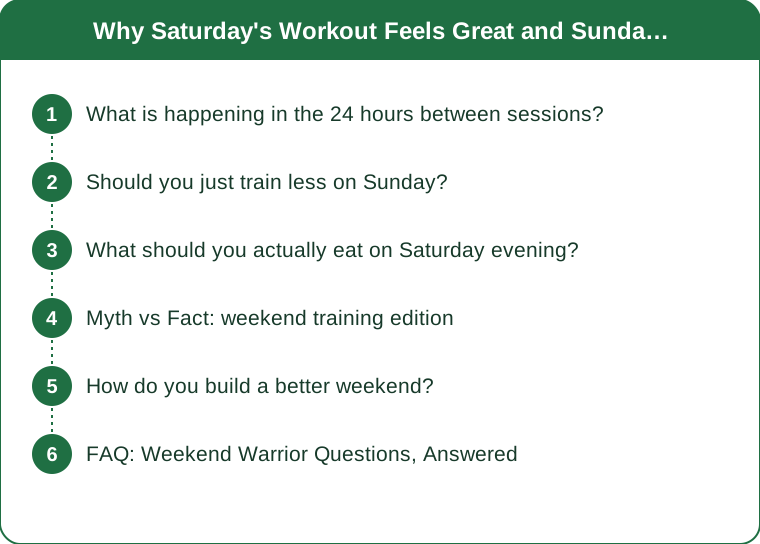
What is happening in the 24 hours between sessions?
Two separate processes, both working against you on Sunday morning.
Delayed onset muscle soreness comes from microscopic damage to muscle fibers, particularly from eccentric loading — the lowering portion of any movement, and the impact absorption in running or hiking. It does not peak immediately; it builds over 24 to 72 hours, which means Sunday morning is usually worse than Saturday evening was.
Glycogen replenishment is the other. Full restoration after a demanding session takes roughly 20 to 24 hours with good carbohydrate intake, and considerably longer without it. Most weekend warriors eat a normal Saturday dinner and start Sunday partially depleted.
Add a Saturday night that involves less sleep than usual and the picture is complete.
Should you just train less on Sunday?
Not necessarily — the better move is usually to train differently.
Soreness from Saturday is specific to the muscles and movement patterns you loaded. A Sunday session using different patterns can be done at high quality while the sore tissue recovers.
If Saturday was a long hike or run, Sunday works well as upper body strength or swimming. If Saturday was heavy lower body lifting, Sunday works well as easy cycling or a mobility-focused session. Repeating the same pattern at reduced intensity gives you the worst of both — you are still loading damaged tissue and you are not getting a quality session.
There is also a real case for making Sunday genuinely easy. Two hard days plus five sedentary ones is not a great weekly structure, and the honest fix is usually to move some volume into the week rather than to squeeze more into Sunday.
What should you actually eat on Saturday evening?
Carbohydrate is the priority, and the timing window is more forgiving than supplement marketing suggests — you have several hours, not 30 minutes.
Aim for a substantial carbohydrate portion at the first meal after your Saturday session, plus protein in the range of 25 to 40 grams. Rice, potatoes, pasta, and bread all do the job; the specific source matters much less than the amount.
Under-eating on Saturday night is the most common self-inflicted cause of a bad Sunday, and it is especially common among people training for weight management, who often cut intake on their highest-output day.
Fluid and sodium matter too, particularly after a long outdoor session in warm weather. A Sunday that starts dehydrated will feel bad regardless of what your muscles are doing.

Myth vs Fact: weekend training edition
Myth: Soreness means the workout was effective. Fact: Soreness tracks novelty and eccentric load, not training quality. A well-designed session in a familiar pattern may produce almost none.
Myth: You should push through soreness to build tolerance. Fact: Training sore reduces force output and alters mechanics, which raises injury risk. Repeated bouts do build tolerance, but through progressive exposure, not through pushing through peak soreness.
Myth: Weekend-only training is not enough. Fact: Research on weekend warrior activity patterns has found similar health outcomes to spread-out activity at matched total volume. The pattern is fine; the intensity spike is the risk.
Myth: Stretching Saturday night prevents Sunday soreness. Fact: The evidence for stretching reducing DOMS is weak. Light movement, sleep, and food do more.
How do you build a better weekend?
Put the more demanding and more skill-dependent session on Saturday, when you are freshest. Save the lower-skill, lower-risk work for Sunday.
Alternate the emphasis. If this Saturday was lower body, make next Saturday upper body dominant. This gives each pattern a full week of recovery even though you are training every weekend.
Add one 20-minute weekday session, ideally Wednesday. This single change does more for weekend performance than any recovery protocol, because it keeps tissue accustomed to loading instead of asking it to go from zero to hard every seven days.
And build in a genuine easy weekend every fourth or fifth week. Weekend-only training accumulates fatigue slowly, and the accumulation is invisible until something complains.
FAQ: Weekend Warrior Questions, Answered
Is it dangerous to only train on weekends?
The research on activity patterns suggests the health benefits are comparable at matched volume. The elevated risk is musculoskeletal — going hard after five sedentary days is where strains happen. A midweek session addresses it.
Should I take an ice bath after Saturday?
Cold immersion reduces soreness sensation but may blunt some training adaptations. If Sunday performance is the priority, it can help. If long-term adaptation is the priority, skip it.
How do I know if Sunday soreness is a problem rather than normal?
Soreness that is symmetrical, diffuse, and improves with light movement is normal. Sharp, localized pain, or pain that worsens with movement, is different and worth attention from a professional. This is general information, not medical advice.
TL;DR:
- DOMS peaks 24 to 72 hours out, so Sunday catches Saturday’s rising curve.
- Partial glycogen replenishment stacks on top of it.
- Change the movement pattern on Sunday rather than just reducing the intensity.
- Eat real carbohydrate Saturday evening, and add one short weekday session.
The weekend warrior pattern works fine. It just needs a Wednesday, a Saturday dinner worth eating, and a Sunday that is a different workout rather than a worse version of yesterday’s.
Keep Reading
This article is for general informational and styling purposes only. Fit, sizing, and product availability may vary.