Why Soreness Peaks on Tuesday After a Big Weekend
Quick Answer: Delayed onset muscle soreness typically begins 12 to 24 hours after unfamiliar exercise, peaks between 24 and 72 hours, and resolves within about five to seven days. It is driven by microscopic damage from eccentric contractions - the lengthening phase, like walking downhill or lowering a weight - followed by an inflammatory repair response that takes time to build. A Saturday morning session peaking on Tuesday is squarely inside the normal window, and a longer, harder or more downhill-heavy session pushes it toward the late end.
Sunday you felt smug.
By Tuesday morning you were lowering yourself onto chairs with both hands and mentally reviewing every decision you made on Saturday.

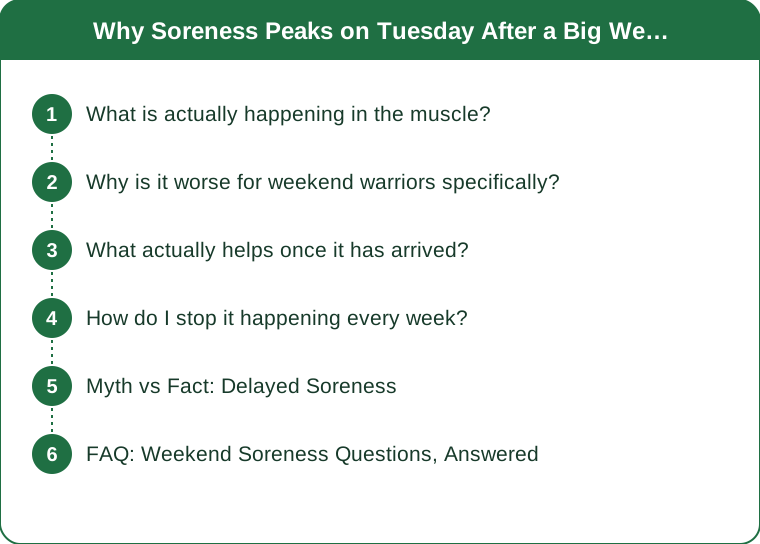
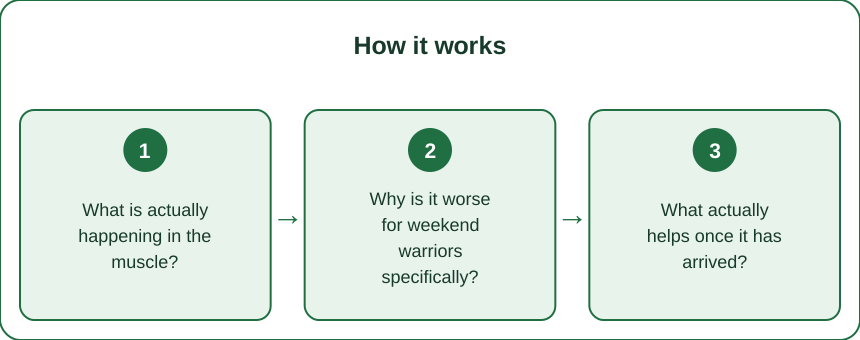
What is actually happening in the muscle?
Eccentric contractions cause microscopic damage to muscle fibres, and eccentric work - lowering, descending, decelerating - is far more damaging than concentric work at the same effort.
The inflammatory response builds over hours, which is why the pain arrives after the event rather than during it.
Swelling within the muscle increases pressure on surrounding tissue, contributing to the ache and stiffness.
Nerve endings become sensitised by inflammatory chemicals, so ordinary pressure and stretch feel painful.
Peak soreness at 24 to 72 hours matches the time course of that inflammatory cascade.
And it is a repair process, not an injury - the muscle emerges more resistant to the same stimulus, which is the whole point of the adaptation.
Why is it worse for weekend warriors specifically?
Novelty drives the response, and doing something once a week keeps it novel indefinitely.
The repeated bout effect means the same session done regularly produces far less soreness within two or three exposures.
Weekend sessions tend to be long, and duration matters as much as intensity for damage accumulation.
They are often downhill-heavy or impact-heavy - hiking, trail running, team sports - which loads the eccentric side hard.
Five days off allows sensitivity to reset, so each weekend is close to a first exposure.
Which is why the answer is a small midweek session, not a harder or gentler weekend.
What actually helps once it has arrived?
Light movement, which increases blood flow and reliably reduces the sensation for several hours - a walk, easy cycling, gentle mobility.
Continue moving through the week rather than waiting it out, since immobility makes stiffness worse.
Protein intake supports the repair, and total daily intake matters more than timing.
Sleep is where most of the repair happens, which makes the Sunday and Monday nights the highest-value intervention.
Massage and foam rolling produce modest short-term relief, which is worth having even though they do not speed the underlying repair.
And be careful with anti-inflammatories, since routine use around training may blunt some of the adaptation you were training for.
This is general information, not medical advice.

How do I stop it happening every week?
Add one short midweek session that includes some of the same movement pattern - even 20 minutes changes the repeated bout picture substantially.
Include eccentric work deliberately - controlled lowering, downhill walking, step-downs - since that is the specific stimulus you are trying to adapt to.
Progress weekend volume gradually rather than jumping from a two-hour hike to a five-hour one.
Warm up properly, which does not prevent soreness but does reduce injury risk on cold weekend mornings.
Do not chase soreness as a marker of quality, since it correlates poorly with training effect and mostly reflects novelty.
And expect the second and third weeks of a new activity to be far easier, which is the repeated bout effect doing exactly what it should.
Myth vs Fact: Delayed Soreness
Myth: soreness is caused by lactic acid.
Fact: lactate clears within about an hour of exercise ending. It has nothing to do with pain that starts the next day. The mechanism is microscopic damage from eccentric contraction plus the inflammatory repair response.
Myth: soreness means it was a good workout.
Fact: soreness mostly reflects how unfamiliar the work was. Well-trained athletes make excellent progress with very little soreness, and a new activity can leave you wrecked without producing much adaptation.
Myth: stretching prevents it.
Fact: stretching before or after has been repeatedly shown to have little effect on delayed soreness. It has other benefits; this is not one of them.
Myth: you should rest completely until it clears.
Fact: light activity reduces the sensation and does not impair recovery. Complete rest tends to prolong the stiffness.
Myth: an ice bath after the session prevents it.
Fact: cold water immersion may modestly reduce soreness in the short term, and regular use after strength training appears to blunt some adaptations. Useful occasionally in a competition block, not as a routine.
FAQ: Weekend Soreness Questions, Answered
How long should soreness last?
Usually resolving within five to seven days, peaking between 24 and 72 hours. Beyond a week is worth paying attention to.
When is soreness a sign of injury?
Sharp or localised pain rather than diffuse ache, pain during the activity rather than after, swelling in a joint, or pain that worsens rather than improves after day three.
Should I train on sore muscles?
Light work on the same muscles is fine and often helpful. Heavy work on significantly sore muscles raises injury risk and produces poorer quality training.
Does dark urine after a big weekend matter?
Dark cola-coloured urine with severe soreness and swelling needs urgent medical assessment - it can indicate rhabdomyolysis, which is rare but serious.
Why does downhill hurt more than uphill?
Downhill is eccentric work - the muscle lengthens under load - which produces substantially more microscopic damage than the concentric work of climbing.
How much midweek work is enough?
Surprisingly little. Twenty to thirty minutes once or twice, including the relevant movement pattern, changes the following weekend noticeably.
This is general information, not medical advice.
TL;DR:
- Delayed soreness starts 12 to 24 hours out, peaks at 24 to 72, and clears in about five to seven days.
- The cause is eccentric-contraction damage plus an inflammatory repair response - not lactic acid.
- Weekend warriors get it repeatedly because a five-day gap keeps every session novel.
- Light movement, sleep and adequate protein help; stretching does not, and complete rest prolongs stiffness.
- One 20 to 30 minute midweek session with the same movement pattern changes the following weekend substantially.
Tuesday is not a punishment. It is the schedule.
Keep Reading
This article is for general informational and styling purposes only. Fit, sizing, and product availability may vary.