Why the First League Game of Fall Injures More People Than Any Other
Quick Answer: Season openers concentrate risk because you arrive with detrained tissue, play at competitive intensity from the first minute, and do it in cooler air with a warmup built for summer. Muscle strains cluster in exactly these conditions, and the fix is three weeks of preparation before the first game — not a longer warmup on the day.
Every league has it. Opening weekend, and by Sunday night the group chat has two hamstrings and a calf.
Nobody got injured in July playing pickup. The opener is different, and it is different in ways that are entirely predictable.
That also means it is largely preventable, which is the more useful half of the observation.

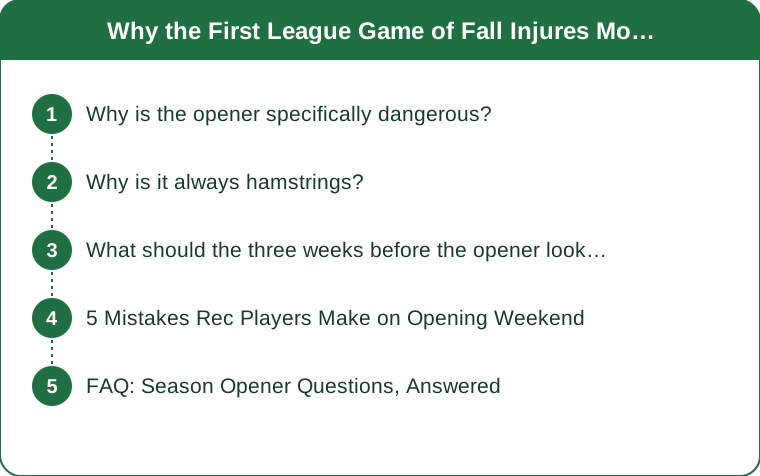
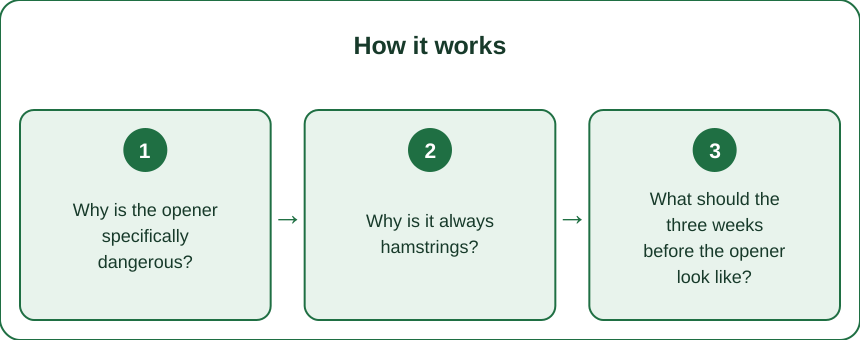
Why is the opener specifically dangerous?
Four factors arrive on the same afternoon.
Detraining. Tissue adapts to what you do. If your summer was walking, casual cycling and one gym session a week, your muscles and tendons have adapted to that. Sprinting is a fundamentally different demand, and the tissue tolerance for it declines within weeks of not doing it. You show up with legs that have not sprinted since spring.
Competitive intensity from minute one. Pickup is self-regulating — you jog when you are tired, nobody sprints for a loose ball in the first two minutes. A league game with a scoreboard is not self-regulating. Maximal efforts happen in the first five minutes, which is exactly when tissue is least prepared.
Cooler air. A fall opener is often the first cool game of the year. Muscle is stiffer at lower temperatures, and a warmup calibrated for an 85°F July evening does not achieve the same tissue temperature at 55°F. The warmup that felt sufficient all summer is now genuinely too short.
Novel surfaces and shoes. New season, new field, sometimes new cleats. Fields in fall are wetter and softer or harder and torn up depending on the weather, and both change how your foot loads.
Muscle strain risk concentrates around high-velocity eccentric loading of cold, detrained tissue. The opener produces all four words in that phrase simultaneously.
Why is it always hamstrings?
Because the hamstring’s most demanding job is the one that only happens at high speed.
During sprinting, the hamstring works hardest not when it is pulling your leg back, but during the late swing phase — decelerating your lower leg as it extends forward, while the muscle is lengthening under high tension. That is eccentric loading at near-maximal length, and it is the classic strain mechanism.
Crucially, this loading pattern occurs at high speed and essentially nowhere else. Jogging does not produce it. Cycling does not produce it. A weights session usually does not produce it. So a summer of general activity leaves the hamstring completely unprepared for its highest-risk task.
The calf fails for a related reason — it takes the highest forces during push-off and change of direction, and it is another muscle that stays untested through a summer of moderate activity.
The useful conclusion: general fitness does not protect against sprint injuries. You need to have sprinted, recently, at something close to full speed, before you sprint competitively.

What should the three weeks before the opener look like?
This is the actual answer, and it needs to happen before the day.
Sprint, before the season starts. Two sessions a week for three weeks. Build from 70 percent effort to near-maximal over that period: start with 6 x 40m at 70 to 80 percent with full recovery, and by week three include 4 to 6 at 90 percent plus. This is the single most protective thing available, and almost nobody does it.
Add Nordic hamstring curls. The best-evidenced hamstring injury prevention exercise there is, with large reductions in strain rates across multiple studies. 2 sets of 5 slow reps, twice a week. They are genuinely unpleasant and they work.
Do calf raises, including single leg. 3 sets of 12 to 15, twice a week, with a slow lowering phase. Calf strains are the second most common opener injury and this is the direct preparation.
Play the sport before you play the game. A single session of the actual movements — cutting, backpedaling, jumping — a week before the opener does more than three weeks of gym work for movement-specific preparation.
Then, on the day, warm up longer. In cool weather, 15 to 20 minutes with a genuine progression: easy jogging, dynamic mobility, then build-up sprints at 60, 80 and 95 percent. That last part is the piece rec players skip universally, and it is the piece that matters. Do not go from jogging straight into a competitive sprint.
Stay warm on the sideline. A substitute who sits for twenty minutes and then sprints onto a cold field is the highest-risk person on the roster. Keep moving, keep layers on.
5 Mistakes Rec Players Make on Opening Weekend
1. Treating the warmup as a formality. Standing around passing is not a warmup. If your heart rate has not risen and you have not sprinted at least once, you are not warmed up.
2. Static stretching instead of dynamic. Long static holds before a game can temporarily reduce force output and do not raise tissue temperature. Dynamic movement through range is what prepares tissue. Save the long holds for after.
3. Playing the full game. The opener is the worst game of the season to play 90 minutes of. Rotating out more than usual is the smart play, not the soft one.
4. Ignoring the tweak. A hamstring that gives you a warning sensation in the first half is a hamstring telling you exactly what is about to happen. Coming off at that point is a two-day problem instead of a six-week one.
5. Skipping the return check. If you have had a strain before, the previous injury is one of the strongest predictors of the next one. That history warrants more preparation, not the same amount.
FAQ: Season Opener Questions, Answered
Is it too late if the opener is next week?
No. Even one or two build-up sprint sessions in the week before produces meaningful preparation, and it is dramatically better than nothing. Do them with full recovery between reps.
How long does a hamstring strain actually take?
It varies enormously by grade — a mild strain might be two to three weeks, a moderate one considerably longer. Returning early is the main cause of recurrence, and recurrence rates are high. Get it assessed rather than guessing. This is general information, not medical advice.
Does age make this worse?
Somewhat — tissue elasticity declines and recovery slows. But detraining is a much bigger variable than age. A well-prepared 45-year-old is at lower risk than an unprepared 25-year-old.
What about a compression sleeve?
Sleeves may help with comfort and proprioception and there is limited evidence they prevent strains. They are not a substitute for having sprinted before you sprint.
Should I be doing anything different in cold weather specifically?
Longer warmup, keep layers on until kickoff, and re-warm if you have been sitting on the bench. Muscle temperature is the mechanism, and cool air works against you the entire game.
TL;DR:
- Openers combine detrained tissue, competitive intensity from minute one, cool air, and a summer-length warmup.
- Hamstrings dominate because their highest-risk loading only happens at near-maximal sprinting, which a summer of general activity never produces.
- Prepare for three weeks: build-up sprints twice a week, Nordic curls, single-leg calf raises.
- On the day, warm up 15 to 20 minutes and include sprints at 60, 80 and 95 percent before the whistle.
- Rotate off more than usual, stay warm on the sideline, and treat any warning sensation as the end of your game.
The opener does not injure people because it is the first game. It injures people because it is the first sprint.
Keep Reading
This article is for general informational and styling purposes only. Fit, sizing, and product availability may vary.