Why Your Desk Week Decides How Your Weekend Sport Feels
Quick Answer: Forty hours of sitting shortens hip flexors, switches off glutes, and stiffens the thoracic spine. Then you ask that body to sprint, cut, and change direction for ninety minutes with no transition. The weekend injury is usually a weekday problem, and ten minutes a day through the week does more for it than any pre-game warmup.
Every Monday you feel it and every Monday you conclude you are getting older or need to train more.
The more useful diagnosis is that you spent five days in one position and one afternoon in the opposite one, and the body had no bridge between them.

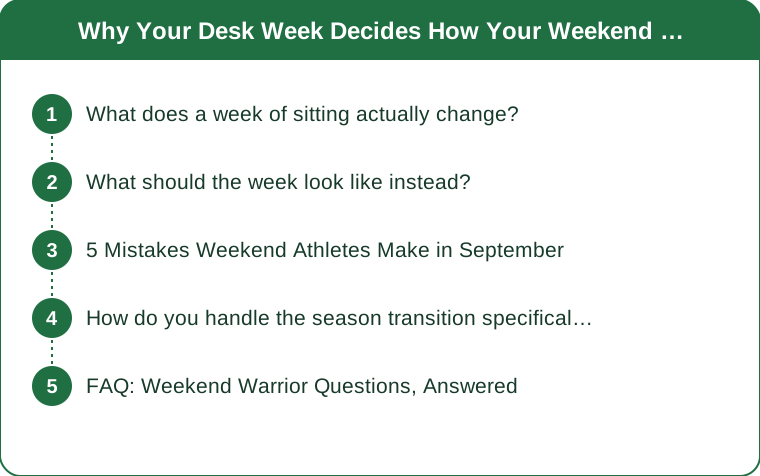
What does a week of sitting actually change?
Three things that matter enormously for sport, all of them reversible.
Hip flexors adapt to a shortened position. Sitting holds the hip at roughly ninety degrees for hours a day, and tissue adapts to the position it spends the most time in. On Saturday you ask that hip to extend fully during a sprint, and it resists - which limits your stride, shifts load elsewhere, and is the mechanical setup behind a lot of hamstring and lower back complaints.
Glutes get quiet. Sitting on them all day, without ever asking them to produce force, reduces how readily they activate. Then in a game they are the primary engine for sprinting and cutting, and if they are slow to fire, the hamstrings take a larger share of the work than they should. This is a well-described pattern behind weekend hamstring strains.
The upper back stiffens. A week of a rounded, forward posture reduces thoracic rotation, and rotation is what throwing, swinging, and turning all need. Restricted rotation up top means the lower back rotates more to compensate, which it is not designed to do.
And your nervous system has not done anything fast in five days. Sport requires rapid coordination, and the last time you produced it was last weekend.
The pattern that follows is entirely predictable: a body optimized for sitting is asked to do the opposite for two hours at high intensity, with a fifteen-minute warmup as the only transition.
What should the week look like instead?
Small, frequent, and specific - not more training.
Ten minutes a day beats one long session. The problem is the accumulated hours in one position, and the antidote is frequency. A short daily routine works far better than a single midweek gym session that then leaves two more sedentary days before the game.
Hip flexor work daily. A couple of minutes of half-kneeling hip flexor stretching with an active glute squeeze on the same side. The glute squeeze matters - it makes the stretch effective rather than passive.
Glute activation before you need it. Glute bridges, banded walks, or single-leg bridges. Two or three times a week, twenty or thirty repetitions total. This is not training, it is reminding.
Thoracic rotation daily. Seated or on the floor, rotate through the upper back in both directions. Thirty seconds each way, and it makes a noticeable difference to how a swing or a throw feels by the weekend.
Something fast at least once midweek. Even a few short accelerations or some skipping. Going from zero fast movement to a competitive sprint is where the strain risk concentrates.
And break up the sitting. Standing for calls, walking during meetings, or simply getting up every hour. The total time sitting matters more than any single stretch you do afterward.
The goal is not to build fitness in ten minutes a day. It is to arrive on Saturday in a body that has not spent five days becoming unsuited to what you are about to ask of it.

5 Mistakes Weekend Athletes Make in September
1. Treating the first game as a fitness test. The first competitive fixture after a summer break is the single highest-risk session of the year, and going full intensity in it is how the season starts with a strain. Two lower-intensity sessions before the first real one changes the whole autumn.
2. Doing all their training on the weekend. A pattern of five sedentary days and two very hard ones produces the worst possible loading distribution. Even one short midweek session dramatically flattens the spike.
3. Warming up for the sport but not for the week. A good pre-game warmup handles the last fifteen minutes. It cannot undo forty hours of sitting, and expecting it to is the core error.
4. Ignoring the shoes. Last season’s boots or court shoes have compressed midsoles and worn studs, and autumn surfaces are wetter and softer than the ones they were last used on. This is a cheap fix that people postpone until something happens.
5. Playing through the Monday soreness into the next weekend. Soreness that has not cleared by midweek is information about your recovery capacity, and the standard response - do nothing all week, then play hard again - guarantees the same result. The better response is light movement through the week, which genuinely accelerates recovery.
How do you handle the season transition specifically?
By treating September as a ramp rather than a start.
Build in two or three weeks of progressive intensity before the first competitive fixture, if the fixture list allows. Most weekend athletes go from nothing to full contact in one step.
Add the sport-specific movement early. Cutting, changing direction, and decelerating are the actions that cause injuries, and they are the ones nobody practices before the season. A few minutes of controlled change-of-direction work in the weeks beforehand is genuinely protective.
Respect the surface change. Summer pitches are hard and dry; autumn pitches are soft, wet, and uneven. Studs, footing, and the way you plant all change, and the first wet weekend is when ankles go.
Warm up longer than in summer. Cool air means you are fighting heat loss throughout, so a fifteen-minute August warmup needs to be twenty in October, with more continuous movement and fewer static holds.
And plan the recovery deliberately. A warm dry layer immediately after, food within an hour, and a walk on Sunday rather than complete rest. The Monday you are dreading is largely determined by the two hours after the final whistle.
If you have a recurring injury, this is exactly the point in the season when it will reappear, and the sensible response is to address it now rather than to find out during a game. This is general information rather than medical advice - a physio who can actually assess you is worth more than any article.
FAQ: Weekend Warrior Questions, Answered
Is it better to train hard midweek or rest for the weekend?
One moderate midweek session, generally. Complete rest all week leaves you unprepared, and a hard session two days before a game leaves you fatigued. Moderate, midweek, and finished by Thursday is the reliable pattern.
How long does it take for hip flexors to loosen up?
You will feel a difference within days from daily work, and the meaningful change takes several weeks of consistency. It also reverses quickly if you stop, because the sitting has not gone anywhere.
Why do I get injured at the end of games rather than the start?
Fatigue degrades movement quality and coordination, so late-game movements are performed with less control. Better conditioning helps, and so does being honest about substituting when your technique is deteriorating.
Should I stretch before or after playing?
Dynamic movement before, and static stretching after or on non-playing days. Long static holds immediately before explosive activity are not helpful and cost you body heat in cold weather.
TL;DR:
- Five days of sitting shortens hip flexors, quiets the glutes, and stiffens thoracic rotation, and a fifteen-minute warmup cannot undo it.
- Ten minutes a day through the week - hip flexor work with a glute squeeze, bridges, thoracic rotation - beats one long midweek session.
- Do something fast at least once midweek so the first sprint of the weekend is not the first of the week.
- Treat September as a ramp, replace last season’s shoes before the wet pitches arrive, and warm up longer as the air cools.
Saturday does not decide how Monday feels. Monday through Friday already did.
Keep Reading
This article is for general informational and styling purposes only. Fit, sizing, and product availability may vary.